
NORTH CAROLINA · WORDPRESS DEVELOPMENT
WordPress Development Agency in Cornelius, NC
WordPress should give your team control of everyday website information without making routine edits fragile. AstoundEdge helps build and improve WordPress websites with clear templates, editable content and a release process that protects the working site. The brief starts with your pages, users and required functions, not a long plugin shopping list.
Discuss your wordpress development projectMake service updates repeatable
A Cornelius business using WordPress may update packages, opening information or appointment instructions regularly. Before changing the site, identify how many places each fact appears. If staff must edit the same detail on several pages, a missed copy can leave conflicting information live. Shared fields or reusable sections can make those updates easier to manage.
The editing demonstration should include a real maintenance task, not just a tour of the dashboard. Ask the reviewer to update a service detail, preview it and confirm where it appears. Keep a recovery route for mistakes. The site should support the business's routine work without requiring staff to understand the code that controls the layout.
Planning checks for your business
- Find repeated service facts.
- demonstrate one complete update and preview.
- document how to reverse an accidental content change.
These are questions for your project brief, not descriptions of past client work. The priorities depend on your business, its customers and the information confirmed during review.
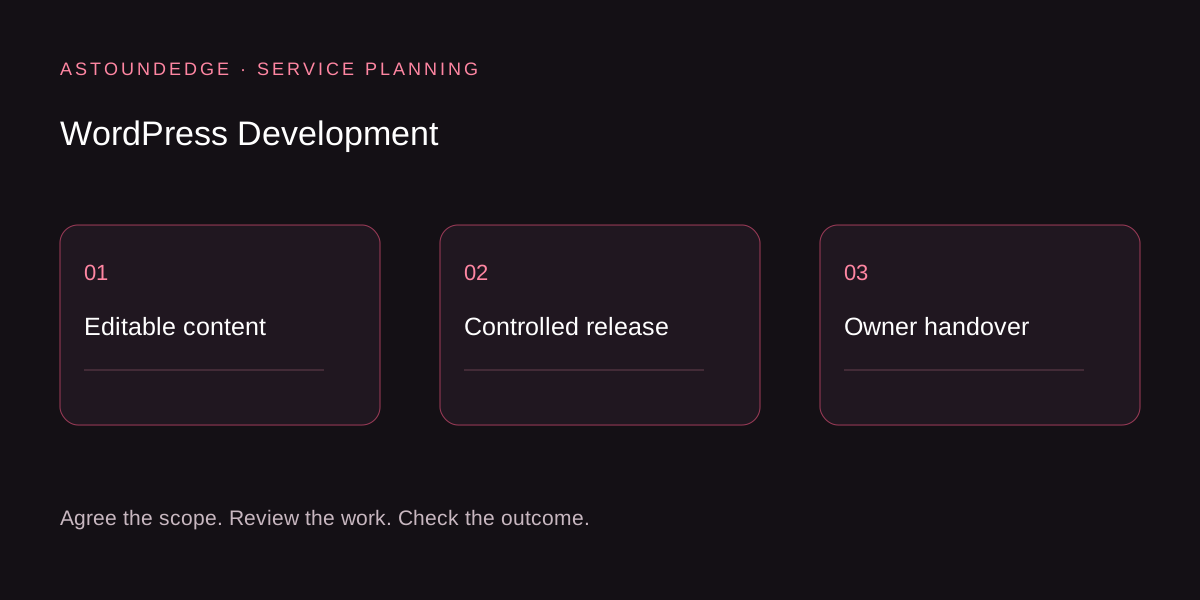
Match the editor to the people using it
A site owner may need to change service text, swap an image or add an article. Those tasks should be possible through a consistent editing workflow. We agree which areas staff can change and which layout rules should remain controlled. A site is not maintainable merely because a login exists; the editor needs to correspond to what appears publicly.
For an existing WordPress site, we inspect the theme, page builder and content structure before recommending changes. Replacing a builder can affect many pages and should not happen casually. Sometimes the right scope is to repair a small number of templates or remove conflicting content rules rather than rebuild the entire site.
Use templates to keep content consistent
Reusable templates can help service pages and articles follow a clear structure. They should support headings, images, related links and the next customer action without forcing every page to say the same thing. Content should remain in WordPress fields where the owner can review and update it. Important business information should not be hidden in code-only replacements.
We review page output with real content, including long headings and mobile screens. The design should account for keyboard access, readable contrast and form labels. Any custom feature needs a documented purpose so a future maintainer can understand why it exists and which pages depend on it.
Choose plugins with ownership in mind
A plugin should solve a defined requirement. Before adding one, consider whether the current setup already handles the task, whether there is an ongoing license and who will maintain it. More plugins can mean more update dependencies and competing behavior. The proposal should identify required tools and any separate costs.
Access should be limited to the roles needed for the work. Credentials and hosting settings remain under the owner's control. Backups, updates and monitoring need an agreed maintenance arrangement; they should not be assumed to continue indefinitely after a development project. A staging environment can help review changes before they reach customers.
Protect search and enquiries during release
Changes to templates can affect headings, canonical URLs, descriptions and the sitemap across many pages. A controlled release includes a recovery copy and checks on the affected scope. Existing URLs should be retained where suitable, and changed paths need relevant redirects. Content that already helps customers should not disappear during a visual refresh.
Forms deserve their own checks. A visible success message, a saved enquiry and an email notification are separate parts of the process. An agreed test plan should verify the intended behavior without sending misleading customer messages. Analytics should distinguish a completed enquiry from a button click or form start.
Make handover part of the build
Before completion, your team should be able to perform the agreed routine edits. Handover can cover page editing, image replacement, publishing responsibilities and the process for reporting a problem. A written record of custom code, plugin dependencies and release changes reduces guesswork when another person maintains the site later.
Share your current WordPress URL, the tasks that are difficult and any required integrations. We can then discuss a repair, added function or wider rebuild with a defined scope. Hosting charges, licenses, copywriting and continuing support should be listed separately unless they are included in the proposal.
Prepare the first discussion
Editing and dependencies
List routine edits, current plugins and the functions the site depends on. Identify who owns hosting, licenses and account access.
Release and support
Agree the review, backup and handover steps. Define continuing maintenance separately so the business knows what happens after development ends.
Begin with the current website and one clearly described business problem. A useful scope records what will change, what information your team must provide and how the finished work will be reviewed. Keep assumptions visible until they have been confirmed. If a requirement changes during the project, agree its effect on the work before it is added.
What to review at completion
A WordPress release record should identify the changed pages or components and the recovery copy used. Confirm that a normal content edit reaches the live page through the agreed workflow. Review the affected links, metadata and forms separately from the visual layout. Keep custom dependencies documented so a later maintainer can assess an update before applying it. Handover should also identify unresolved items and support ownership. This makes completion a reviewable set of checks rather than an assumption that the dashboard being accessible proves the site is ready.
Working with AstoundEdge from Cornelius
Cornelius is part of AstoundEdge's service area. Our operating offices are in Mooresville, North Carolina, and Noida, India; we do not claim a Cornelius office. Work can be discussed remotely, with Mooresville meetings by appointment. Your project can focus on Cornelius customers or a wider audience, but that choice should be explicit in the brief and in the way results are reviewed.
For the broader delivery scope, read our wordpress development service overview. If your project also needs web design and development, the Cornelius web design and development page explains that separate area of work. These links help you compare scope before committing to a project.
Frequently asked questions
Can you keep our current WordPress design?
That can be part of the brief. We first review how the theme and builder work, then identify whether the requested changes can be made while preserving the existing appearance and content.
Will our pages remain editable?
The editing workflow should be agreed and demonstrated. Routine text and image updates should use WordPress fields or the chosen builder rather than require changes to hidden content code.
Does development include ongoing maintenance?
Only when it is included in the agreement. Updates, backups, hosting, license renewals and support responsibilities should be stated explicitly at handover.
Do you have an office in Cornelius?
No. Cornelius is a service area. AstoundEdge operates from Mooresville, North Carolina, and Noida, India. We can discuss projects remotely, and Mooresville office meetings are by appointment.