
NORTH CAROLINA · SHOPIFY DEVELOPMENT
Shopify Development Services in Davidson, NC
A Shopify store should make products understandable and buying straightforward. AstoundEdge helps plan store structure, theme development and the customer journey from a collection page to checkout. We start with your catalog, fulfilment rules and operating workflow so the build reflects how the business actually sells.
Discuss your shopify development projectPrepare a small catalog for daily use
A Davidson business moving a small product range online should focus on complete product information and a manageable update process. A short catalog still needs clear options, stock states and fulfilment information. The store's design should help buyers compare the items rather than add navigation intended for a much larger range.
Use the initial products to establish naming, image and description conventions that staff can repeat. Decide who changes stock information and how discontinued items are handled. A theme handover should demonstrate those tasks. Future catalog growth can be considered in the structure without buying apps or adding complex filters before there is a documented need.
Planning checks for your business
- Set repeatable product conventions.
- demonstrate stock and product updates.
- add catalog complexity only when the range requires it.
These are questions for your project brief, not descriptions of past client work. The priorities depend on your business, its customers and the information confirmed during review.
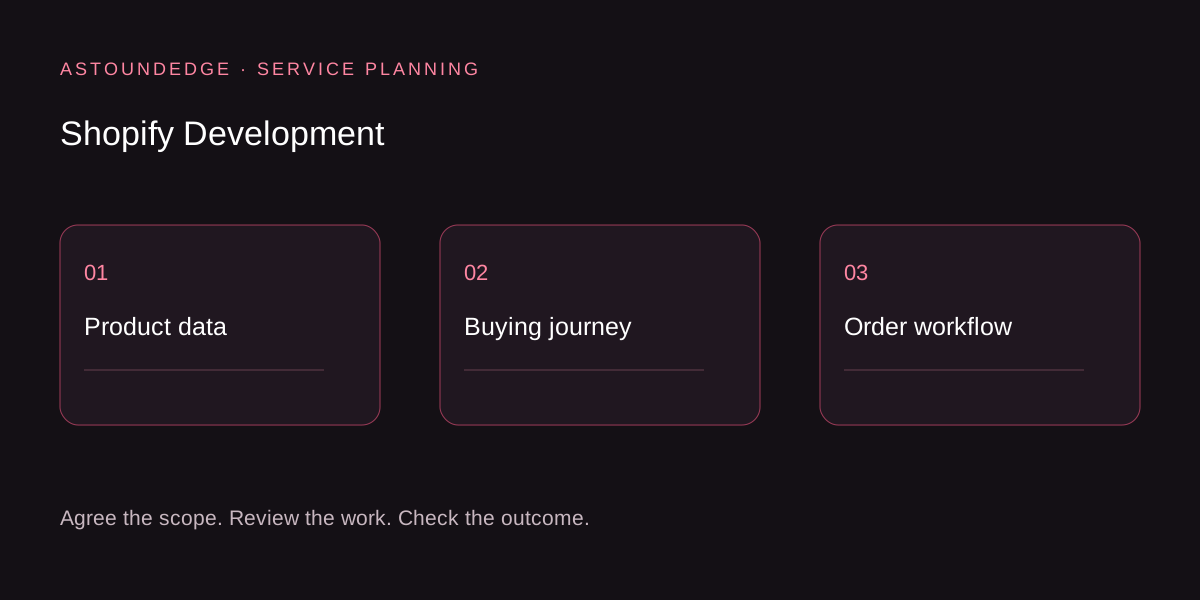
Organize the catalog before styling the theme
Products need clear names, images, options and descriptions. Collections should help a buyer narrow a choice without creating many confusing routes to the same item. Before development, identify the information customers compare: size, material, compatibility, quantity or another real product difference. Missing product facts cannot be solved by changing the color of a purchase button.
We review the catalog size, variants and any existing product data. A migration needs a mapping plan for products, collections and content, with a decision about old URLs. Inventory ownership and fulfilment responsibilities should also be clear. The store's public claims must match the operational process behind the order.
Build a theme around the buying journey
The theme should support product comparison, readable information and clear actions on a phone. Product pages need useful imagery and an understandable selection process. Collection pages need navigation suited to the catalog. A visual design should be reviewed with real products, because placeholder items rarely reveal the complexity of options or long descriptions.
We agree which sections staff can edit and what belongs in reusable templates. Repeated manual changes across many products can become difficult to maintain. Theme changes should be documented so later updates can be assessed. Existing paid theme licenses and any new purchases remain separate decisions, not assumptions within development.
Keep apps and operational rules deliberate
Apps can add functions, but each one brings a cost, access requirement and maintenance dependency. The brief should identify the actual need before adding another tool. Shipping, returns, discounts, subscriptions or product customization may involve different systems and constraints. We confirm which requirements belong in the build and which need a separate product decision.
Store settings should reflect the business's approved rules. Tax, payment and legal policy decisions belong with the appropriate business advisers and account owners. Development can implement approved requirements, but should not invent them. Staff should know which system owns inventory and how an order moves into fulfilment.
Protect search paths during a store change
A redesign or migration should preserve useful URLs where possible and map changed addresses to relevant replacements. Product and collection titles, descriptions, canonical behavior and sitemap visibility need review. Search traffic can arrive on a product page directly, so that page must make sense without requiring a visit to the homepage first.
Images should be sized for their role, with descriptions that help people understand them. We inspect the published store's navigation and page behavior after deployment. Checkout and payment testing need an agreed test method and account-owner involvement where required. A theme preview alone does not confirm that orders, notifications or fulfilment are working.
Plan the handover for daily store work
Your team may need to add products, update stock information, change a banner or manage a collection. These tasks should be demonstrated with the chosen setup. Handover should identify app ownership, recurring charges, theme responsibilities and the route for future changes. Routine store work should not depend on guessing how a custom section was built.
Share your current store, catalog size, required functions and fulfilment process when requesting a scope. We can then separate launch requirements from later additions. Product photography, large-scale data cleanup, paid apps and ongoing marketing should be named explicitly if they are part of the project.
Prepare the first discussion
Catalog and fulfilment
Prepare representative products, variants and the approved delivery process. Identify the system that owns stock information and the staff who maintain it.
Theme and dependencies
List required functions and current apps. Separate paid licenses, operational decisions and optional additions from the core development scope.
Begin with the current website and one clearly described business problem. A useful scope records what will change, what information your team must provide and how the finished work will be reviewed. Keep assumptions visible until they have been confirmed. If a requirement changes during the project, agree its effect on the work before it is added.
What to review at completion
Store acceptance should include representative product options, collection navigation and the approved fulfilment explanations. Check the published theme as well as its preview. Staff should review the information they will receive with an order and demonstrate the routine catalog updates agreed in scope. Record dependencies and unresolved operational questions before launch. Where payment or checkout testing is required, use an agreed method with the account owner. A visible storefront is only one part of completion; the buying and staff workflows must also match the brief.
Working with AstoundEdge from Davidson
AstoundEdge works with Davidson businesses as a service-area provider. Our offices are in Mooresville and Noida, with meetings at Mooresville by appointment. There is no separate Davidson office. Remote reviews can cover the brief, draft content and website changes. The project should reflect your own customers and operating arrangements rather than assume every Davidson business has the same marketing needs.
For the broader delivery scope, read our shopify development service overview. If your project also needs search engine optimization, the Davidson search engine optimization page explains that separate area of work. These links help you compare scope before committing to a project.
Frequently asked questions
Can you improve an existing Shopify theme?
A review can identify whether changes to the current theme will meet the brief. A new theme is not automatically necessary; the decision depends on the required functions, maintainability and current setup.
Are paid apps included?
Paid apps and recurring charges should be approved separately and listed in the scope. We first identify the requirement, then assess whether the current store can support it without another app.
Can you move an existing store to Shopify?
A migration can be scoped after reviewing products, content, URL mapping and operating requirements. Payment, customer data and fulfilment arrangements need careful review before a launch plan is agreed.
Do you have an office in Davidson?
No. Davidson is a service area. AstoundEdge operates from Mooresville, North Carolina, and Noida, India. We can discuss projects remotely, and Mooresville office meetings are by appointment.