
NORTH CAROLINA · SOCIAL MEDIA MARKETING
Social Media Marketing Agency in Cornelius, NC
Social content should give people a reason to understand your business, remember it and take the next step when they need you. AstoundEdge helps plan social media around your offer, available material and approval process. Instagram and Facebook can be part of that plan, with channel choices based on your customers and the work your team can sustain.
Discuss your social media marketing projectUse social content to reduce uncertainty
A Cornelius service business can use social posts to explain what happens before, during and after an appointment. That content can answer practical questions without exposing a customer's details. The team might explain what information to prepare or how a service is scoped. These are subject ideas for planning, not claims about client work or results.
Decide which questions can be answered publicly and which should move to a private business conversation. The person handling messages needs access to approved service information and a route for questions they cannot answer. The content calendar should leave room for corrections and current operating information rather than lock the account into promotions that may no longer apply.
Planning checks for your business
- Outline the appointment journey.
- approve answers to common concerns.
- define when a message should move to the service team.
These are questions for your project brief, not descriptions of past client work. The priorities depend on your business, its customers and the information confirmed during review.
Choose the purpose before the posting schedule
A useful social plan starts with a business question. You may need to explain an unfamiliar service, support repeat purchases, answer common objections or help prospective customers understand who they will work with. Those purposes require different posts. A calendar filled with unrelated awareness days can keep an account busy without helping a buyer.
We review the current account, website destination and material your team can supply. Channel selection should consider where your customers are likely to look and how the business will respond. Running every platform is not automatically a better use of time than maintaining a smaller number of accounts with clear responsibilities.
Turn real business material into content
Product details, process explanations, staff introductions and answers to customer questions can give a content calendar substance. Photos and video should represent your business accurately and have the necessary permission for use. Client names, private work and results should not be posted without approval. If evidence is unavailable, we explain the service rather than making claims on your behalf.
A draft should have a clear subject, a readable opening and one suitable next step. Images need legible text at phone size, and video needs an understandable message even when sound is off. Captions, image descriptions and links are part of the deliverable, not details to add after publication.
Set a workable approval and response process
The plan should identify who supplies information, who approves content and how far ahead posts are prepared. That avoids last-minute requests for material that does not exist. A shared review stage lets the business correct facts, remove sensitive details and check that the tone sounds like the team customers will meet.
Posting and community management are separate responsibilities unless both are included. Agree who handles messages, public comments, complaints and requests for a quote. Service questions may need an employee's answer. Response times should reflect actual staffing rather than a promise that every message will be answered immediately.
Connect social visits to the right next step
A post about a specific service should lead to a page explaining that service. A general homepage can make someone search again for the offer they just saw. The destination should work on a phone, explain what happens after contact and avoid making visitors enter unnecessary details before they understand the business.
Campaign links can help identify recorded website visits from posts. Those visits should be reviewed separately from views, reactions and follower totals. A person may engage with a post without becoming a customer, while another may return later through a different channel. Reporting needs to acknowledge those limits rather than assigning every enquiry to the last post.
Use reporting to decide what to repeat
Review content by its purpose. An explanation post may be judged by relevant visits and questions; a product announcement may be judged by recorded interest in that product. Compare similar formats and date windows, noting whether paid promotion contributed to reach. A large audience outside your service area can make headline totals misleading.
The next calendar should reflect what your team learned and what customers still need to know. Organic account management and paid Meta campaigns are different scopes. Advertising budget, photography, video production and message handling should be named in the proposal so there is no confusion about what the monthly work includes.
Prepare the first discussion
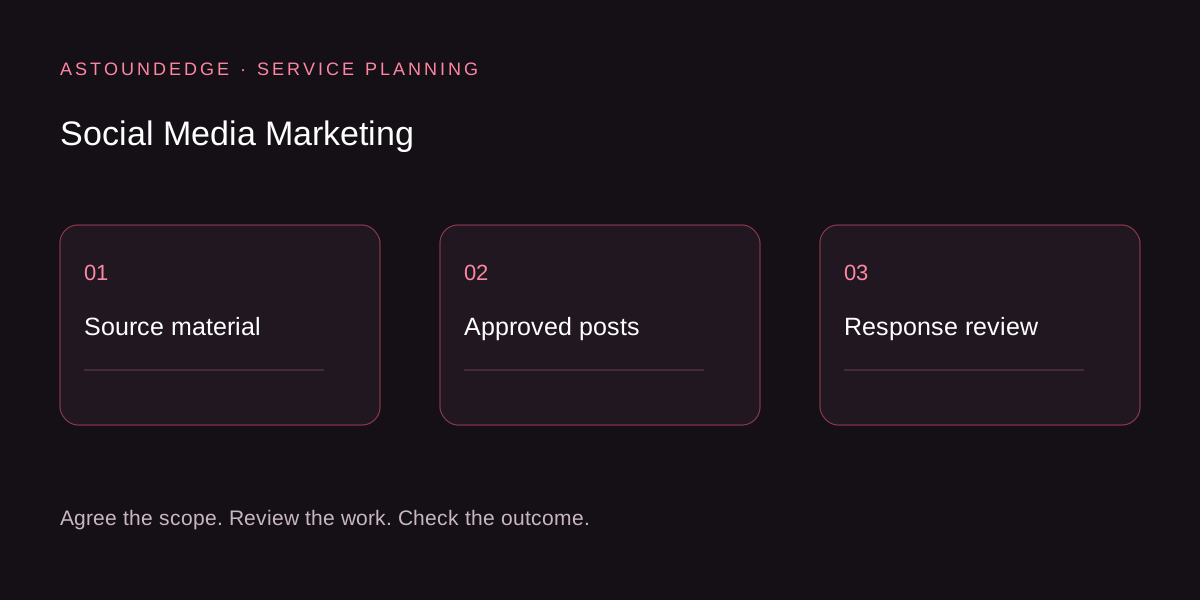
Available source material
List the photographs, product facts and service explanations the team can supply. Note permissions and any material that must remain private.
Approval and response
Name the content reviewer and the person handling customer messages. Publishing and responding need their own responsibilities and agreed scope.
Begin with the current website and one clearly described business problem. A useful scope records what will change, what information your team must provide and how the finished work will be reviewed. Keep assumptions visible until they have been confirmed. If a requirement changes during the project, agree its effect on the work before it is added.
What to review at completion
The publication record should identify the approved post, its destination and the date it went live. Check that the image remains readable on a phone and that links reach the intended page. Keep any paid promotion clearly identified so it is not confused with organic reach. If an offer changes after publication, the team needs a route to correct or remove the outdated message. The review should also confirm who is responsible for questions that arrive after the post, including those outside the planned publishing window.
Working with AstoundEdge from Cornelius
Cornelius is part of AstoundEdge's service area. Our operating offices are in Mooresville, North Carolina, and Noida, India; we do not claim a Cornelius office. Work can be discussed remotely, with Mooresville meetings by appointment. Your project can focus on Cornelius customers or a wider audience, but that choice should be explicit in the brief and in the way results are reviewed.
For the broader delivery scope, read our social media marketing service overview. If your project also needs paid advertising management, the Cornelius paid advertising management page explains that separate area of work. These links help you compare scope before committing to a project.
Frequently asked questions
Do we need to post on every social platform?
No. Choose channels based on your customers, available content and ability to respond. A focused plan with clear ownership is usually easier to maintain than opening accounts without a publishing or response process.
Can we approve posts before they go live?
An approval stage can be included in the agreed workflow. The proposal should name the reviewer, review dates and how factual corrections are handled before content is scheduled.
Does social media management include paid ads?
Only when that is included in the scope. Organic posts, paid campaign management, advertising spend and content production should be listed separately so the business knows what it is approving.
Do you have an office in Cornelius?
No. Cornelius is a service area. AstoundEdge operates from Mooresville, North Carolina, and Noida, India. We can discuss projects remotely, and Mooresville office meetings are by appointment.